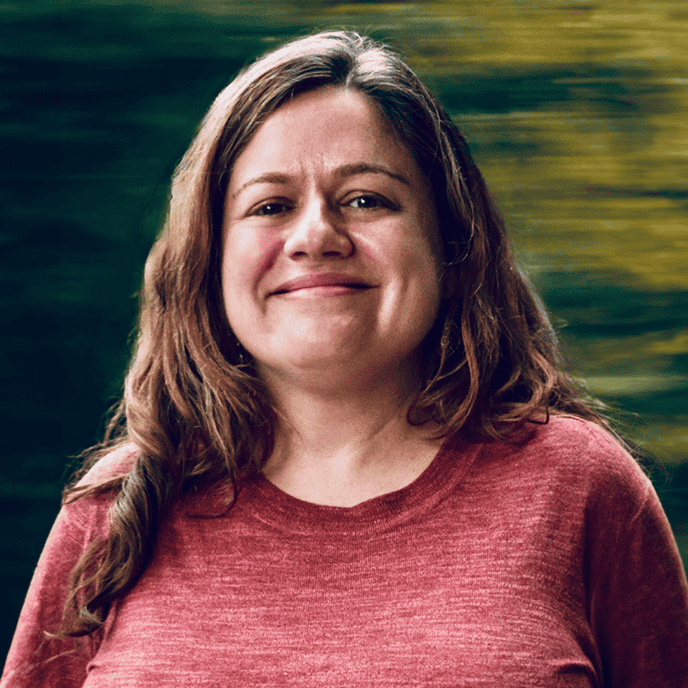
Sílvia da Costa Ferreira
Associate Teaching Professor
School of Interdisciplinary Arts & Sciences
Bothell campus
Describe a challenge you have wrestled with in your teaching
Students often arrive in my first-year composition classes unsure of themselves as writers. I have found that their attitudes toward their writing are largely shaped by past experiences that teach them there is only one way to be a good writer; that to write well is to write in “standard” language, to be free of grammatical errors, to sound like their textbooks. This view limits their potential as writers and limits their belief in the power of their own voices. It also lends fuel to the temptation to outsource their writing to generative AI, which they often believe can surely emulate the conventions of “standard” language and error-free writing better than they can. A challenge that I wrestle with in my teaching is how to persuade students that their authentic writing voice is unique and important, and, more recently, that it cannot and should not be replaced by a machine.
What did you do to solve or overcome that challenge?
One way I have overcome this challenge is by helping students center the unique linguistic assets they bring to their writing. This work begins with interrogating our beliefs around language and what it means to be a good writer. I encourage students to approach the idea of “standard” language as both a myth and a powerful ideology that has shaped what we are taught about writing well. We engage with works by linguists and poets alike in order to understand how the concept of a “standard” language works to uphold racial and other social hierarchies.
After deconstructing the idea of a “standard” language, we move on to center the languages and varieties of language that matter most to us. I see my most important job as a writing professor as helping free students to do their most authentic writing, which, much like many of our lived experiences, often occurs across and between multiple languages and varieties of language. I encourage students to bring their whole selves into their writing by inviting them to experiment with code meshing, which is the practice of blending different languages and varieties of language into a single piece of writing (Hardee). The result is writing that asserts students’ unique voices and identities. Code meshing also helps us challenge hierarchies that subordinate and stigmatize varieties of language used by minoritized groups.
What did you learn from that experience?
I have learned that there can be such a wide gap between students’ confidence in their writing and the tremendous assets, linguistic and otherwise, that they bring to their writing. When students are able to embrace what makes their writing truly unique, they can better envision themselves as writers and appreciate the role of writing in their lives. Now is the time for us to all deepen our understanding of the link between our writing and our thinking, and to better understand the powerful role writing can have in how we assert ourselves in the world. Delving deeper into these links can remind us what is uniquely human about our writing, and what cannot be duplicated by a machine. I believe we are at a moment when the supposed promises of generative AI have made our writing more indispensable, not less. After all, our writing is not just a means to getting our work done; our writing is the work itself.