A learning outcome is a simple, concise statement that tells students what they should be able to do as a result of working through your course. Developing measurable learning outcomes is the first step in ensuring that your course is aligned, one of UW’s core elements of effective teaching. Measurable learning outcomes can help instructors and programs determine if learners are achieving the goals we’ve set for them.
Developing measurable learning outcomes
Bloom’s Taxonomy is a framework that helps instructors design clear, measurable learning outcomes. The framework offers a structured way to think about the cognitive processes involved in learning, and it organizes these processes into levels that progress from foundational skills to those that are more complex. Often presented as a pyramid, as presented below, Bloom’s aids in the creation of learning outcomes, supports the alignment of assignments and curriculum, and helps to guide students in the development of higher-order thinking skills.
Bloom’s Taxonomy
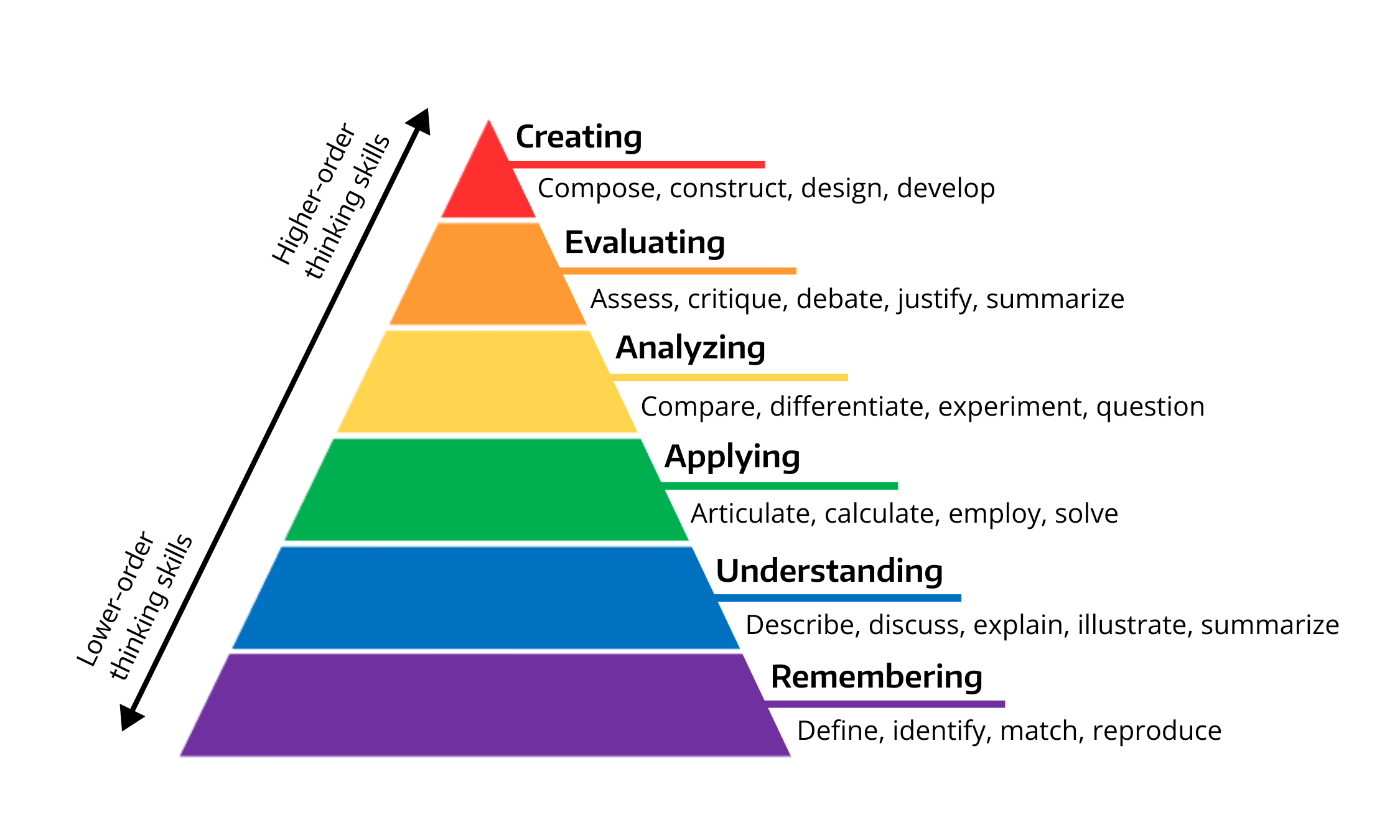
Bloom’s Taxonomy is shown as a pyramid. The highest level at the top represents higher‑order thinking skills, and the levels progress downward to lower‑order thinking skills. From top to bottom, the pyramid is labeled:
- Creating
- Compose, construct, design, develop
- Evaluating
- Assess, critique, debate, justify, summarize
- Analyzing
- Compare, differentiate, experiment, question
- Applying
- Articulate, calculate, employ, solve
- Understanding
- Describe, discuss, explain, illustrate, summarize
- Remembering
- Define, identify, match, reproduce
Measurable learning outcomes
How can you tell if your learning outcomes are “measurable”? Consider the following sample learning outcome:
“Learners will understand the difference between X and Y.”
How will you know whether learners “understand” the difference between X and Y? To get a sense of whether learners “understand” something, you need to observe them doing something else, such as correctly identifying or articulating something or performing some action. Eliminate vague verbs like understand, know, learn, realize, and appreciate from our learning outcomes and replace them with verbs that describe the actions your learners will take to demonstrate their understanding. Here’s a measurable version of our sample learning outcome:
“Learners will be able to differentiate X from Y.”
One benefit of measurable learning outcomes is that they can point toward potential assessment methods that align with the outcome. Using the sample above, an instructor could develop a quiz question that asks learners to match the terms X and Y with the correct examples or definitions. Or we could assign a short essay that asks learners to explain how X and Y differ.
The importance of sharing outcomes with students
Though essential for aligning your course, learning outcomes are ultimately for students. First and foremost, learning outcomes “communicate your intentions to students, and they give students information to better direct their learning efforts and to monitor their own progress” (Lovett, et al, How Learning Works, 2nd ed., p. 244). Sharing your outcomes with students can also boost engagement by helping students see the relevance of what they are doing in your class.
Here are some situations where sharing your learning outcomes with students makes sense:
- Syllabus – This is an initial step in framing your course and setting expectations for students.
- First day of class – Spend some time talking about the “why” behind your learning outcomes. Here’s your opportunity to highlight how the skills students will develop on your course (i.e., your learning outcomes) will help them at UW and after graduation
- Assignment instructions – Noting which course learning outcome(s) the assignment helps students work toward can help students see the relevance of the assignment.
Test your knowledge!
Below are sample learning outcomes. Read each outcome and determine whether or not it represents a measurable learning outcome. Check your answers to learn more about why it is or is not measurable.
- Yes, this learning outcome is measurable. The verb “define” provides a clear sense of how this outcome could/will be assessed in the course. Students can demonstrate their ability to define terminology through a variety of assessment methods.
- No, this learning outcome is not measurable. The verb “understand” does not provide a clear sense of how this outcome will be assessed in the course.
- Revised SLO example: “Students will be able to explain design criteria for existing products.”
- No, this learning outcome is not measurable. The verb “learn” is vague and does not provide a clear sense of how this outcome will be assessed in the course.
- Revised SLO example: “In this course, students will use statistical methods to analyze a variety of data.”
- No, this learning outcome is not measurable. The verb “understand” is vague and does not provide a clear sense of how this outcome will be assessed in the course.
- Revised SLO example: “By the end of this course, students will be able to critically analyze the arguments in both primary and secondary sources.”
- Yes, this learning outcome is measurable. The verb “assess” provides a clear sense of how this outcome will be assessed in the course. Students can demonstrate their ability to define terminology through a variety of assessment methods.
- Yes, this learning outcome is measurable. The verb “write” provides a clear sense of how this outcome will be assessed in the course.