Traditionally, instructors have used class time to introduce new content via lecture, and then left students to practice and apply that content by themselves in homework exercises. A flipped classroom model “flips” this use of class time.
In a flipped model, instructors typically introduce new content through pre-recorded lectures (using technology such as Panopto) and/or assigned reading. This homework prepares students to come to class ready to engage in activities that promote higher-order thinking, such as analyzing or synthesizing information through discussion, hands-on work, and collaboration – activities which have been shown to increase students’ learning and academic performance.
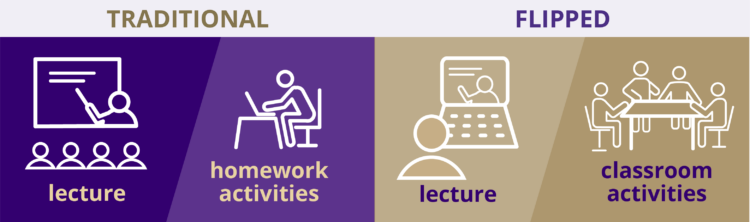
Allowing students to engage new ideas asynchronously has a lot of benefits. Shifting your lecture from an in-person lecture to a video lets students watch (and rewatch) the information at any time, pausing when they need to. This benefits all learners, but is especially helpful for learners who are slow notetakers or for whom English is an additional language. This also frees up in-class time for deeper dives into the content – students are then in a better position to ask questions, work together, and wrestle with complex concepts.
How to flip your class
- Identify what students will need to learn and to participate in class. Flipping a class begins with your learning outcomes. What key concepts do you want students to know and what skills do you want them to be able to demonstrate as a result of taking your class
- Develop resources and pre-class activities that introduce key concepts and prepare students to participate in class. Create resources (e.g., video lectures, assigned readings, animations, diagrams, etc.) would best give students the knowledge they need to participate in class and share them in your course’s Canvas site. To motivate students, you might also ask them to complete simple assignments that allow students to check their comprehension (e.g., practice quizzes, short reflections).
- Develop in-class activities that ask students to apply the concepts. Now that you’ve shifted the introduction of new concepts to pre-class work, you can focus class time on digging deeper and helping students apply concepts. What sorts of activities would help students deepen their understanding? Consider asking students to work together on a problem or set of problems, apply a concept to a scenario, or connect a concept to their own experiences. Learn more about active learning strategies.